Quick Answer
- Glucosamine is a popular over-the-counter supplement for joint pain. Evidence that it meaningfully relieves arthritis symptoms is mixed at best.
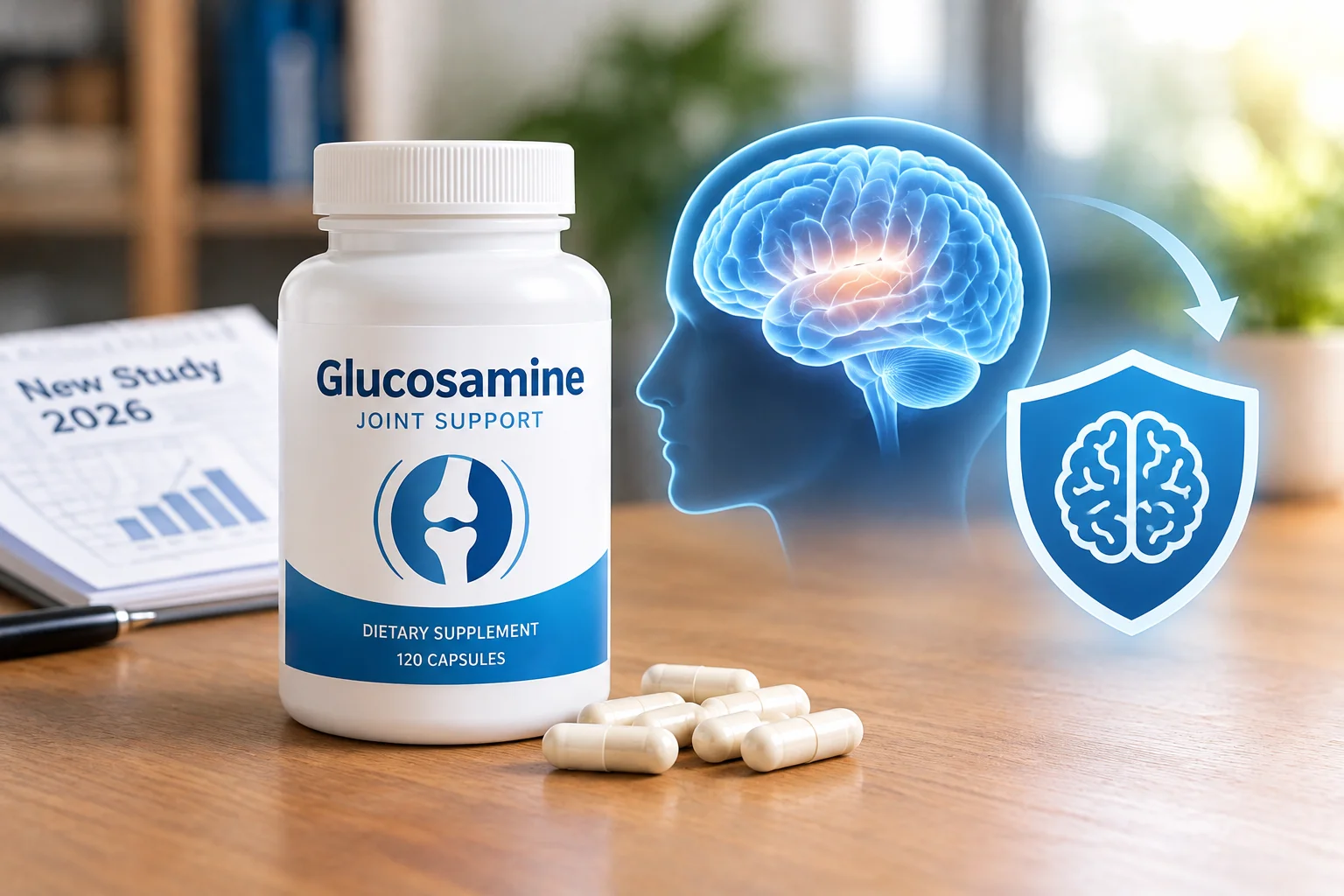
- A 2026 study in Nature Metabolism found that among people with mild cognitive impairment, those taking glucosamine were 25% more likely to progress to dementia than non-users.
- This is one observational study, not proof of cause and effect, and a follow-up analysis has already questioned parts of it. It's a reason to talk with your doctor if you have cognitive concerns, not a reason to panic.
Glucosamine sits in millions of medicine cabinets, usually next to the fish oil, taken daily by people hoping to ease creaky knees and stiff joints. A study published this year in Nature Metabolism is raising a question nobody expected to ask about it: could it affect the brain, too?
Researchers at the University of Florida found that among people already diagnosed with mild cognitive impairment, those who used glucosamine were more likely to progress to dementia than those who didn't. Here's what the study actually looked at, what it found, and where the evidence gets shakier.
What Is Glucosamine?
Glucosamine is a natural compound found in cartilage, the tissue that cushions your joints. As a supplement, it's typically made from shellfish shells or fermented corn and sold either on its own or combined with chondroitin, another cartilage-related compound. Together, glucosamine and chondroitin have been marketed for decades as a way to ease joint pain and slow cartilage breakdown, particularly in osteoarthritis.
Does Glucosamine Work for Joint Pain?
The evidence here has long been underwhelming. Large clinical trials, including the well-known GAIT trial funded by the National Institutes of Health, have found that glucosamine performs little better than a placebo for most people with knee osteoarthritis, though a subgroup with moderate-to-severe pain saw some benefit. Most major clinical guidelines, including from the American College of Rheumatology, now recommend against glucosamine for knee osteoarthritis, citing weak evidence of benefit. None of this made it dangerous, which is part of why it remained so popular. That's the backdrop the new brain-related finding lands on.
What the New Study Found
Researchers combed deidentified health records from the University of Florida health system, covering 2012 to 2024, using an AI-assisted analysis. They focused on patients diagnosed with either dementia or mild cognitive impairment (MCI), the earlier stage of memory and thinking decline that sometimes precedes it. About 8% of both groups reported taking glucosamine.
After adjusting for age, sex, and other demographic factors, the researchers found that glucosamine use was associated with a 25% higher likelihood that mild cognitive impairment would progress to dementia. Among people already diagnosed with dementia, glucosamine use was also linked to a higher mortality risk in the original analysis.
The researchers didn't stop at the health records. In a companion experiment, mice bred to develop an aggressive, accelerated form of Alzheimer's disease were given glucosamine, and their social memory (the ability to recognize other mice) got measurably worse. The team also found evidence that glucosamine may promote a process called hyperglycosylation, which can interfere with how brain cells function. That gives the statistical finding a plausible biological mechanism behind it, rather than leaving it as a coincidence in the data.
Where the Evidence Gets Shakier
This is exactly the kind of finding that deserves a second look before it changes anyone's behavior, and researchers have already started giving it one. It's also a reminder of why we push for third-party testing and manufacturing transparency when we evaluate supplement brands — popular doesn't automatically mean well studied.
A follow-up analysis posted in July 2026 re-examined the same type of health record data and raised an important point: when glucosamine users were compared with people taking other, similar over-the-counter supplements, rather than with non-users generally, the signal became harder to pin specifically on glucosamine. The same paper noted that earlier, larger population studies in people without existing cognitive problems had found no increased dementia risk from glucosamine, or even a slightly lower one. That's a meaningfully different population than the sick, older patients in the new study.
An outside expert who reviewed the findings for Medical News Today made a similar point: the mouse experiments used an aggressive, engineered model of Alzheimer's disease that doesn't necessarily reflect how the disease develops in most people, and the human data show an association, not proof that glucosamine causes faster decline. People who choose to take glucosamine might differ from those who don't in other ways the analysis couldn't fully capture, like activity level, other health conditions, or pain severity, any of which could also affect dementia risk.
What This Means for You
If you don't have memory or thinking concerns, this research doesn't provide strong evidence you need to worry. The signal shows up specifically in people who already had mild cognitive impairment or dementia, in a single-center analysis that a follow-up study has already partly challenged. If you're looking into cognitive support more broadly, our guides to cognitive supplements for focus and stress and magnesium L-threonate and L-theanine cover what does and doesn't hold up in the research.
If you or someone you're caring for has MCI or a dementia diagnosis and takes glucosamine regularly, it's a reasonable thing to bring up at the next doctor's visit, especially since the evidence that glucosamine meaningfully helps joint pain was already weak to begin with. That's a different calculation than for someone without cognitive concerns using it for knee pain, where the established risk-benefit picture hasn't fundamentally changed. For a look at how we weigh popular joint and connective-tissue supplements more broadly, see our review of whether collagen peptides actually work, which runs into a similar pattern: pooled positive results that shrink once you separate out the strongest, most independent evidence.
Clinical Evidence at a Glance
| Claim | Evidence Level | What Research Suggests |
|---|---|---|
| Glucosamine relieves knee osteoarthritis pain | Large randomized controlled trials | Little better than placebo for most people; major guidelines recommend against it for knee osteoarthritis |
| Glucosamine use is linked to faster progression from MCI to dementia | Retrospective health-record analysis, single health system | 25% higher likelihood of progression; association only, not proof of cause |
| Glucosamine worsens memory in a mouse Alzheimer's model | Animal research | Social memory declined in mice given glucosamine; model reflects an aggressive, engineered disease form |
| The dementia-risk signal is specific to glucosamine itself | Follow-up observational re-analysis | Signal weakened when compared against other supplement users rather than non-users; earlier studies in healthier populations found no increased risk |
The Bottom Line
A widely used joint supplement has been linked, in one study, to faster cognitive decline in people who already have memory problems, with a plausible biological explanation behind it. That's worth taking seriously, particularly if you or a loved one falls into that specific group. But a single observational study, already facing pushback from researchers re-examining the same data, isn't the same as proof that glucosamine harms the brain. If you have cognitive concerns and take glucosamine, talk with your doctor. If you don't, this is a story worth watching, not a reason to throw out the bottle tonight.
Frequently Asked Questions
Does glucosamine work for joint pain?
The evidence is weak. Large clinical trials have found it performs little better than placebo for most people with knee osteoarthritis, and major medical guidelines now recommend against it for that use.
Does glucosamine chondroitin work?
Similar to glucosamine alone, evidence for the combination is mixed, with some trials showing modest benefit in people with moderate-to-severe pain and others showing no meaningful difference from placebo.
Does glucosamine cause dementia?
No single study has proven that. A 2026 analysis found glucosamine use was associated with faster progression from mild cognitive impairment to dementia, but this is an observational finding, and a follow-up analysis has already raised questions about how specific the signal is to glucosamine itself.
Is glucosamine safe?
For most healthy adults, glucosamine is generally considered safe, with mild side effects like digestive upset being most common. The new research raises a more specific question about its use in people who already have cognitive impairment or dementia, which is worth discussing with a doctor.
Should I stop taking glucosamine?
That depends on why you're taking it and your health history. If you take it for joint pain and have no cognitive concerns, the new findings don't provide strong evidence to stop. If you or someone you care for has mild cognitive impairment or dementia, it's a reasonable topic to raise with a doctor at your next visit.
References
- University of Florida Health. Study Links Joint Pain Supplement to Accelerating Dementia. 2026. View article
- ScienceDaily. Glucosamine, a Popular Joint Supplement, Linked to Faster Alzheimer's Progression. 2026. View article
- Comparator Supplement Patterns Qualify the Clinical Interpretation of an EHR-Derived Glucosamine Signal in Alzheimer's Disease, 2026. View preprint
- Medical News Today. Dementia: Joint Pain Supplement May Speed Up Progression. 2026. View article

The Health Findings Lab Research Team is a dedicated group of health writers, data analysts, and editorial reviewers. Operating under strict, evidence-based editorial guidelines, the team synthesizes peer-reviewed clinical literature to provide objective insights. Our collaborative approach ensures that every review prioritizes verifiable efficacy and manufacturing transparency over marketing hyperbole.